
This collection of buddha quotes gathers 250 lines from the Dhammapada, the discourses of the Buddha, and the early Buddhist teachings, organized by theme, from peace and mindfulness to anger, love, karma, and awakening. Siddhartha Gautama, the Buddha, taught in northern India more than two thousand years ago, yet his words on the mind, suffering, and compassion are quoted today in meditation halls, classrooms, and homes around the world.
Lines drawn directly from the Dhammapada and the discourses are labeled “Buddha”, while widely circulated lines with no verbatim source in the early texts are labeled “Attributed to Buddha” rather than presented as certain, and a short note at the end names the famous lines that later teachers, not the Buddha, actually wrote. Every line here was checked against our existing collections so that nothing in this article repeats a quote already published on CrownQuote.

In this collection (17)
- Editor’s Picks
- 1. Peace and Calm
- 2. Mindfulness and the Present Moment
- 3. The Mind and Thoughts
- 4. Anger and Forgiveness
- 5. Love and Compassion
- 6. Happiness and Contentment
- 7. Suffering and Letting Go
- 8. Wisdom and Truth
- 9. The Path and Practice
- 10. Life and Death
- 11. Karma and Action
- 12. Patience and Perseverance
- 13. Enlightenment and Awakening
- How to Use These Quotes in Daily Life
- Frequently Asked Questions
- A Short Note on Attribution
Readers come to buddha quotes for different reasons: some want a calm line for the morning, others want a steady reminder in a hard week, and many simply want the Buddha’s voice in plain, honest language. Whatever brings you here, these buddha quotes are arranged so you can read straight through or jump to the theme you need today.
Editor’s Picks
| Quote | Best For |
|---|---|
| “A tamed mind brings happiness.” — Buddha | Daily calm |
| “Hatred is never appeased by hatred in this world. By non-hatred alone is hatred appeased. This is a law eternal.” — Buddha | Ending conflict |
| “Radiate boundless love towards the entire world.” — Buddha | Loving-kindness |
| “Just as a mother would protect her only child with her life, even so let one cultivate a boundless love towards all beings.” — Buddha | On compassion |
| “If with a pure mind a person speaks or acts, happiness follows him like his never-departing shadow.” — Buddha | On happiness |
| “Conquer the angry one by not getting angry; conquer the wicked by goodness; conquer the stingy by giving; conquer the liar by speaking the truth.” — Buddha | On anger |
| “You yourself must strive. The Buddhas only point the way.” — Buddha | On the path |
| “Ardently do today what must be done. Who knows? Tomorrow, death comes.” — Buddha | On urgency |
| “All conditioned things are impermanent. When one sees this with wisdom, one turns away from suffering.” — Buddha | On impermanence |
| “Be a lamp unto yourselves. Be a refuge unto yourselves.” — Buddha | On self-reliance |
1. Peace and Calm
- “Whether in village or in forest, in valley or on hill, wherever the arahants dwell, that place is delightful.” — Buddha
- “Hatred is never appeased by hatred in this world. By non-hatred alone is hatred appeased. This is a law eternal.” — Buddha
- “Delightful are the forests where the worldly find no delight. There the passionless find delight, for they seek no sensual pleasures.” — Buddha
- “A man is not called wise because he talks and talks again; but if he is peaceful, loving, and fearless, then he is in truth called wise.” — Buddha
- “Calm is his thought, calm his speech, and calm his deed.” — Buddha
- “Though one should recite a hundred verses composed of useless words, yet better is one verse of Dhamma, hearing which one attains peace.” — Buddha
- “Do not speak harshly to anyone. Those who are spoken to will answer in the same way. Angry speech is painful, and the rod of retribution will fall on you.” — Buddha
- “If, like a cracked gong, you silence yourself, you have already reached Nibbana, for no quarrel will be found in you.” — Buddha
- “Even though one is well-dressed, if one is calm, controlled, and lives a holy life, abandoning the rod toward all beings, that one is a brahmana, a recluse, a monk.” — Buddha
- “Though one should live a hundred years without self-control, yet better is a single day’s life of one who is self-controlled.” — Buddha
- “Thousands of candles can be lit from a single candle, and the life of the candle will not be shortened. Happiness never decreases by being shared.” — Attributed to Buddha
- “If you knew what I know about the power of giving, you would not let a single meal pass without sharing it in some way.” — Attributed to Buddha
- “Where in this world is there a man restrained by shame, who holds back blame as a good horse holds back the whip?” — Buddha
- “Why is there laughter? Why is there joy when this world is always burning? Shrouded in darkness, why do you not seek a light?” — Buddha
- “The royal chariots, well-painted, wear out; the body too wears out. But the Dhamma of the good does not wear out. The good teach it to the good.” — Buddha
- “A tamed mind brings happiness.” — Buddha
- “Victory breeds hatred, for the conquered is unhappy. He who has given up both victory and defeat, he, the contented, is happy.” — Buddha
- “There is no fire like passion, there is no shark like hatred, there is no snare like folly, there is no torrent like greed.” — Buddha
- “The gift of truth excels all other gifts.” — Buddha
- “If with a pure mind a person speaks or acts, happiness follows him like his never-departing shadow.” — Buddha
What these teach: Peace is not found outside but built inside. When hatred, craving, and fear quiet down, the mind settles into a calm that no circumstance can take away.
2. Mindfulness and the Present Moment
- “Be where you are; otherwise you will miss your life.” — Attributed to Buddha
- “The past is already gone, the future is not yet here. There is only one moment for you to live.” — Attributed to Buddha
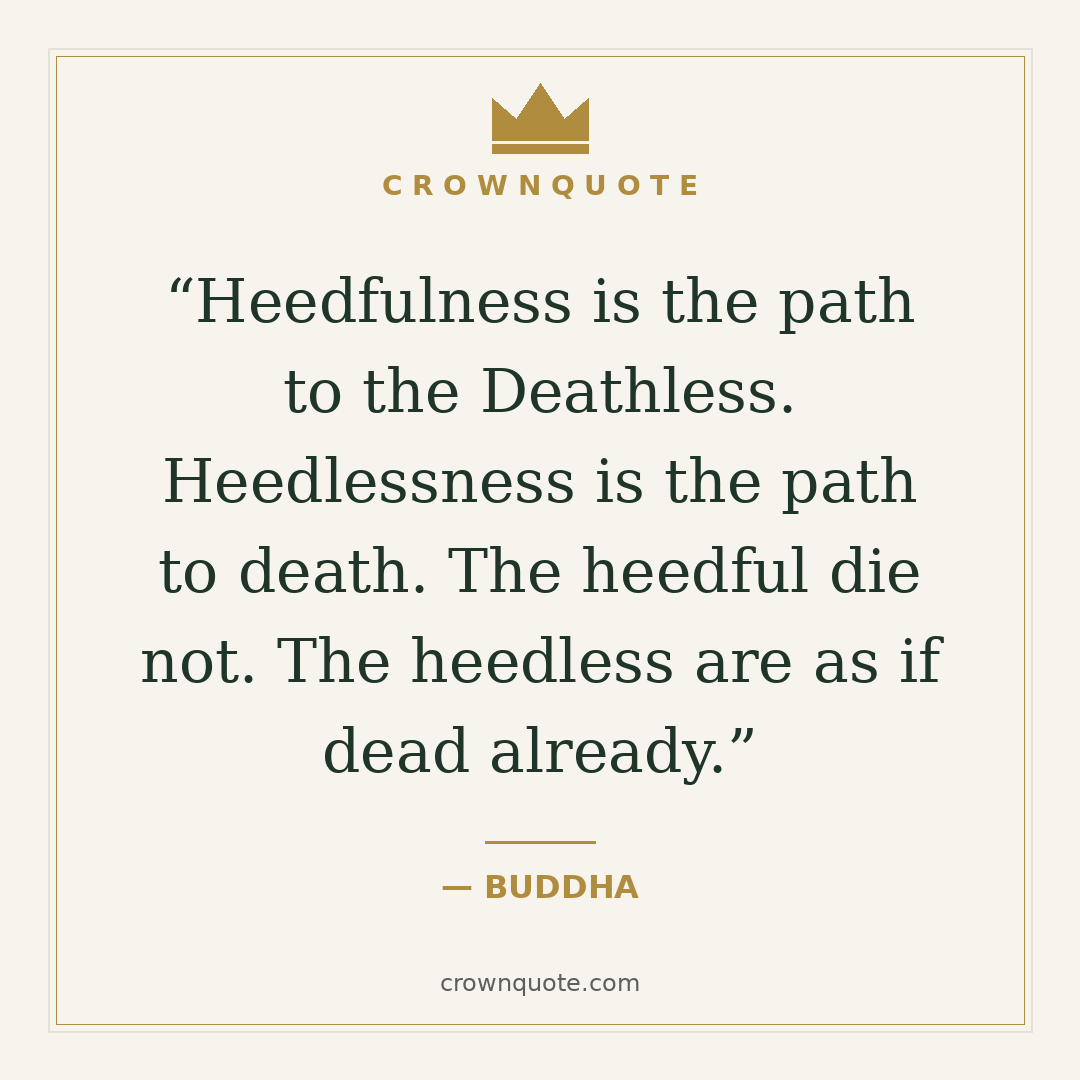
- “Heedfulness is the path to the Deathless. Heedlessness is the path to death. The heedful die not. The heedless are as if dead already.” — Buddha
- “Clearly understanding this excellence of heedfulness, the wise exult in heedfulness and enjoy the company of the noble ones.” — Buddha
- “If a man lives a pure life, nothing can destroy him.” — Attributed to Buddha
- “Whatever words we utter should be chosen with care, for people will hear them and be influenced by them for good or ill.” — Attributed to Buddha
- “Every human being is the author of his own health or disease.” — Attributed to Buddha
- “The mind is hard to see, subtle, flitting wherever it listeth. The wise man guards his mind. A guarded mind brings happiness.” — Buddha
- “Believe nothing, no matter where you read it, or who said it, no matter if I have said it, unless it agrees with your own reason and your own common sense.” — Attributed to Buddha
- “The mind wanders far and alone, bodiless, resting in the cave of the heart. Those who control it are freed from the bonds of Mara.” — Buddha
- “The man whose mind is unsteady, who does not know the true Dhamma, whose serenity is disturbed, does not attain wisdom.” — Buddha
- “The man whose mind is not stained by passion, who is free from hatred, who has abandoned good and evil, who is vigilant, knows no fear.” — Buddha
- “Knowing this body to be like a clay pot, and fortifying this mind like a city, one should fight Mara with the weapon of wisdom, and guard one’s conquest, remaining unattached.” — Buddha
- “The mind can go in a thousand directions, but on this beautiful path, I walk in peace.” — Attributed to Buddha
- “Just as the great ocean has one taste, the taste of salt, so also this teaching and discipline has one taste, the taste of freedom.” — Buddha
- “Better it is to live one day seeing the rise and fall of things than to live a hundred years without ever seeing the rise and fall of things.” — Buddha
- “Better it is to live one day wise and meditative than to live a hundred years foolish and uncontrolled.” — Buddha
- “One who acts on truth is happy in this world and beyond.” — Attributed to Buddha
- “When you realize how perfect everything is, you will tilt your head back and laugh at the sky.” — Attributed to Buddha
What these teach: Mindfulness is attention to the present moment. The past is gone and the future has not arrived, so the only place life can actually be lived is now.
3. The Mind and Thoughts
- “Neither mother, father, nor any other relative can do more for a man than his own well-directed mind.” — Buddha
- “As a fletcher makes straight his arrow, a wise man makes straight his trembling and unsteady thought, which is difficult to guard, difficult to hold back.” — Buddha
- “It is a man’s own mind, not his enemy or foe, that lures him to evil ways.” — Buddha
- “By ourselves is evil done; by ourselves we pain ourselves. By ourselves we cease to do evil; by ourselves we become clean.” — Buddha
- “As rain breaks through an ill-thatched house, passion will break through an unreflecting mind.” — Buddha
- “As rain does not break through a well-thatched house, passion will not break through a well-reflecting mind.” — Buddha
- “Who will conquer this earth, the realm of death, and the world of the gods? Who will investigate the well-taught verse of Dhamma as a skillful florist picks flowers?” — Buddha
- “The learner on the path will conquer this earth, the realm of death, and the world of the gods. The learner will investigate the well-taught verse of Dhamma as a skillful florist picks flowers.” — Buddha
- “The root of suffering is attachment.” — Attributed to Buddha
- “Knowing this body to be like foam, understanding its mirage nature, one should cut off the flower-tipped arrows of Mara and pass beyond the sight of the King of Death.” — Buddha
- “As a great flood carries away a sleeping village, so death carries away the man who gathers only flowers, whose mind is distracted.” — Buddha
- “The man who gathers only flowers, whose mind is distracted, who is insatiate in sensual pleasures, him the King of Death brings under his sway.” — Buddha
- “A man should first direct himself in the way he should go. Only then should he instruct others.” — Buddha
- “Let no man think lightly of evil, saying in his heart, it will not come nigh unto me.” — Buddha
- “Let no man think lightly of good, saying in his heart, it will not come nigh unto me.” — Buddha
- “If a traveler does not meet a companion who is better or equal, let him firmly pursue his solitary course.” — Buddha
- “The fool who knows his foolishness is wise at least so far. But a fool who thinks himself wise, he is called a fool indeed.” — Buddha
- “A fool, even though he associates with a wise man all his life, understands the Dhamma no more than a spoon the flavor of soup.” — Buddha
- “An intelligent man, even though he associates with a wise man only for a moment, quickly understands the Dhamma, as the tongue tastes the flavor of soup.” — Buddha
- “As the bee gathers nectar and departs without harming the flower, its color, or its fragrance, so should the sage wander in the village.” — Buddha
What these teach: The mind shapes experience. Guard it, train it, and direct it well, and it becomes a friend; leave it untrained, and it becomes the enemy.
4. Anger and Forgiveness
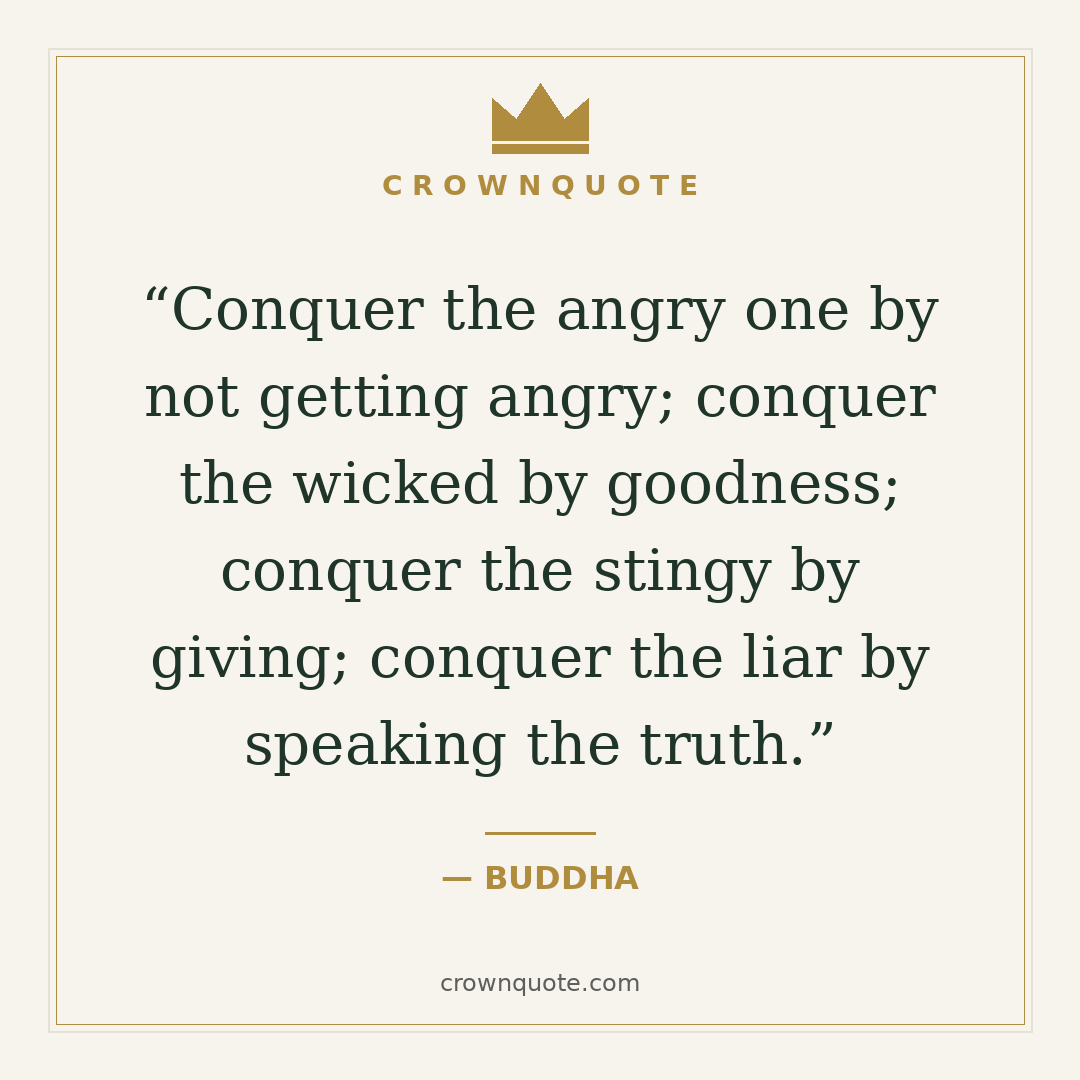
- “Conquer the angry one by not getting angry; conquer the wicked by goodness; conquer the stingy by giving; conquer the liar by speaking the truth.” — Buddha
- “He who holds back rising anger like a rolling chariot, him I call a real driver; other people are but holding the reins.” — Buddha
- “The fool, while doing evil deeds, does not know them to be evil. The fool, by his own deeds, is tormented as if burnt by fire.” — Buddha
- “Whoever, by the rod, harms those who are harmless and innocent will soon come to one of these ten states.” — Buddha
- “Speak the truth; do not yield to anger; give, if thou art asked for little; by these three steps thou wilt go near the gods.” — Buddha
- “The evil-doer grieves here and hereafter; he grieves in both the worlds.” — Buddha
- “The doer of good rejoices here and hereafter; he rejoices in both the worlds.” — Buddha
- “If a man speaks or acts with an evil thought, pain follows him, as the wheel follows the foot of the ox that draws the carriage.” — Buddha
- “The greatest prayer is patience.” — Attributed to Buddha
- “Patient endurance is the highest ascetic practice.” — Buddha
- “He will be subject to harsh pain, loss, injury to the body, serious illness, or derangement of mind.” — Buddha
- “Those who are ever vigilant, who study day and night, who are wholly intent on Nibbana, their defilements come to an end.” — Buddha
- “Do not give your attention to what others do or fail to do; give it to what you do or fail to do.” — Buddha
- “The tongue like a sharp knife kills without drawing blood.” — Attributed to Buddha
- “Words have the power to both destroy and heal. When words are both true and kind, they can change our world.” — Attributed to Buddha
- “In a controversy, the instant we feel anger we have already ceased striving for the truth, and have begun striving for ourselves.” — Attributed to Buddha
- “This is an old saying: they blame one who sits silent, they blame one who speaks much, they blame one who speaks little. There is no one in this world who is not blamed.” — Buddha
- “To be angry is to let others’ mistakes punish yourself.” — Attributed to Buddha
- “Let a man leave anger, let him forsake pride, let him overcome all fetters.” — Buddha
What these teach: Anger harms the angry first. Meeting anger with patience, truth, and goodness is not weakness but the only victory that ends the cycle.
5. Love and Compassion
- “Radiate boundless love towards the entire world.” — Buddha
- “Just as a mother would protect her only child with her life, even so let one cultivate a boundless love towards all beings.” — Buddha
- “Let none through anger or ill-will wish harm upon another.” — Buddha
- “If you truly loved yourself, you could never hurt another.” — Attributed to Buddha
- “Compassion and wisdom are the two wings of enlightenment.” — Attributed to Buddha
- “Good friends, companions, and associates are the whole of the spiritual life.” — Buddha
- “To support mother and father, to cherish wife and children, and to be engaged in peaceful occupation, this is the greatest blessing.” — Buddha
- “The thing that is disliked by me is also disliked by others. Since I dislike this thing, how can I inflict it on someone else?” — Buddha
- “A noble one produces an abundance of merit by having a compassionate mind towards all living beings.” — Buddha
- “May all beings be happy and secure, may all beings be happy-minded.” — Buddha
- “If we could see the miracle of a single flower clearly, our whole life would change.” — Attributed to Buddha
- “As rain falls equally on the just and the unjust, do not burden your heart with judgements but rain your kindness equally on all.” — Attributed to Buddha
- “If you light a lamp for somebody, it will also brighten your path.” — Attributed to Buddha
- “Happiness comes when your work and words are of benefit to yourself and others.” — Attributed to Buddha
- “One moment can change a day, one day can change a life and one life can change the world.” — Attributed to Buddha
- “May all beings be free from suffering and the causes of suffering.” — Attributed to Buddha
- “The way is not in the sky. The way is in the heart.” — Attributed to Buddha
- “Meditation brings wisdom; lack of meditation leaves ignorance. Know well what leads you forward and what holds you back, and choose the path that leads to wisdom.” — Attributed to Buddha
- “May all beings be safe and protected.” — Attributed to Buddha
- “Give, even if you only have a little.” — Attributed to Buddha
What these teach: Loving-kindness extends without exception. It begins with oneself, embraces family and friends, and finally reaches every living being.
6. Happiness and Contentment
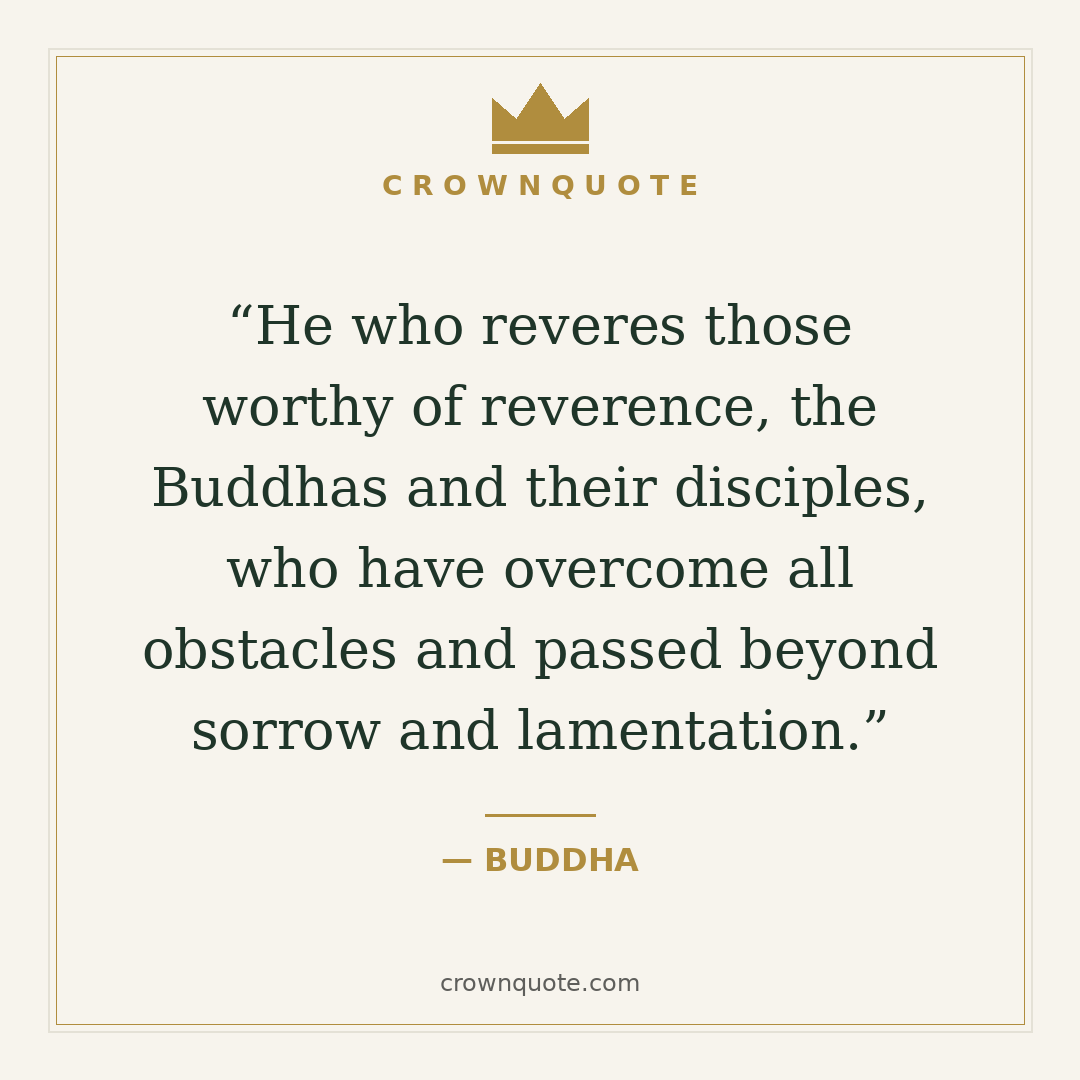
- “He who reveres those worthy of reverence, the Buddhas and their disciples, who have overcome all obstacles and passed beyond sorrow and lamentation.” — Buddha
- “Happy is the birth of Buddhas; happy is the teaching of the sublime Dhamma.” — Buddha
- “The merit of one who reveres those who are worthy of reverence, who are peaceful and free from fear, cannot be measured by anyone.” — Buddha
- “Having tasted the flavor of solitude and the flavor of peace, one is free from fear and evil, drinking the flavor of the joy of Dhamma.” — Buddha
- “Happiness does not depend on what you have or who you are. It solely relies on what you think.” — Attributed to Buddha
- “Let us live happily then, not hating those who hate us. Among men who hate us, let us dwell free from hatred.” — Buddha
- “It is good to see the noble ones; to live with them is always happiness. By not seeing fools, one will be happy forever.” — Buddha
- “All wrong-doing arises because of mind. If the mind is transformed, can wrong-doing remain?” — Attributed to Buddha
- “It is in the nature of things that joy arises in a person free from remorse.” — Attributed to Buddha
- “However many holy words you read, however many you speak, what good will they do you if you do not act upon them?” — Attributed to Buddha
- “Should one find a man who points out faults and who reproves, let him follow such a wise and sagacious man as one would a guide to hidden treasure.” — Buddha
- “There is nothing so disobedient as an undisciplined mind, and there is nothing so obedient as a disciplined mind.” — Attributed to Buddha
- “Happy indeed we live, free from greed among the greedy.” — Buddha
- “Let us live happily then, though we call nothing our own. We shall be like the bright gods, feeding on happiness.” — Buddha
- “Just as a flower which seems beautiful and has color but no perfume, so is the fruitless word of the man who speaks it but does not act.” — Buddha
- “One who consorts with fools grieves for a long time. Association with fools is always painful, as with an enemy. Association with the wise is happiness, as with kinsfolk.” — Buddha
- “Therefore, one should follow the wise, the intelligent, the learned, the patient, the dutiful, the noble. One should follow such a good and wise man as the moon follows the path of the stars.” — Buddha
- “Better it is to live one day virtuous and meditative than to live a hundred years immoral and uncontrolled.” — Buddha
- “Let us live happily then, free from ailments among the ailing. Among men who are ailing, let us dwell free from ailments.” — Buddha
What these teach: Happiness comes from contentment and good deeds, not from possessions. Health, a quiet mind, and a generous heart are the greatest wealth.
7. Suffering and Letting Go
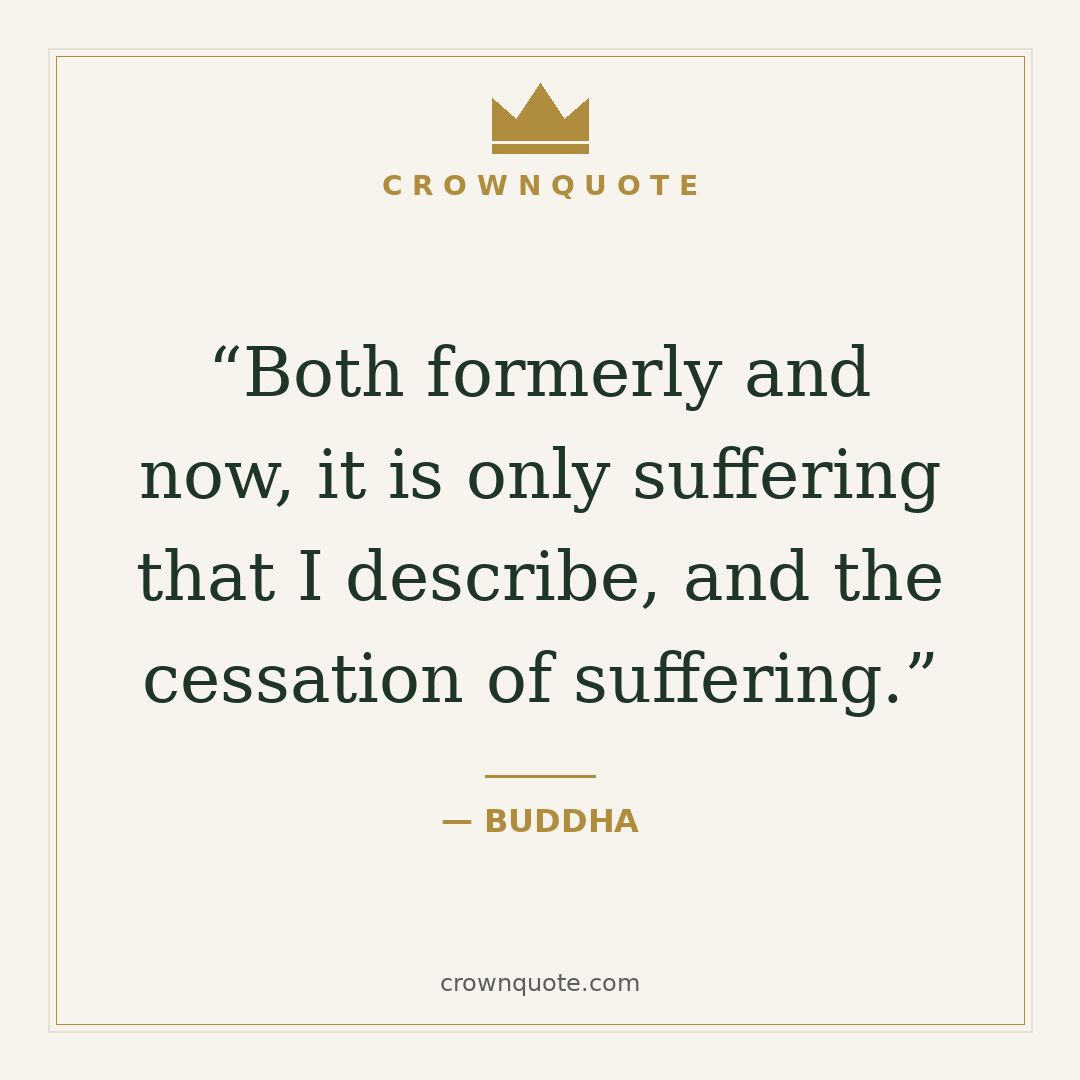
- “Both formerly and now, it is only suffering that I describe, and the cessation of suffering.” — Buddha
- “Therefore hold nothing dear, for separation from the dear is painful.” — Buddha
- “From craving springs grief, from craving springs fear. For him who is wholly free from craving there is no grief, whence then fear?” — Buddha
- “From attachment springs grief, from attachment springs fear. For him who is wholly free from attachment there is no grief, whence then fear?” — Buddha
- “From affection springs grief, from affection springs fear.” — Buddha
- “From lust springs grief, from lust springs fear.” — Buddha
- “From greed springs grief, from greed springs fear.” — Buddha
- “All conditioned things are impermanent. When one sees this with wisdom, one turns away from suffering.” — Buddha
- “All conditioned things are unsatisfactory. When one sees this with wisdom, one turns away from suffering.” — Buddha
- “All things are not-self. When one sees this with wisdom, one turns away from suffering.” — Buddha
- “Let go of the past, let go of the future, let go of the present.” — Buddha
- “Suffering is not holding you. You are holding suffering.” — Attributed to Buddha
- “If you want to fly, give up everything that weighs you down.” — Attributed to Buddha
- “As a cowherd with his staff drives his cattle to pasture, so do old age and death drive the life of beings.” — Buddha
- “You only lose what you cling to.” — Attributed to Buddha
- “Everything changes, nothing remains without change.” — Attributed to Buddha
- “Through many a birth I wandered in samsara, seeking, but not finding, the builder of the house. Sorrowful is birth again and again.” — Buddha
- “Easy to see are the faults of others, difficult indeed to see one’s own.” — Buddha
- “Poison does not affect one who has no wound. Nor is there evil for one who does no evil.” — Buddha
- “The world is afflicted by death and decay. But the wise do not grieve, having realized the nature of the world.” — Attributed to Buddha
What these teach: Suffering begins with craving and clinging, and it ends with letting go. Nothing held tightly can be kept forever, and freedom starts the moment the grip loosens.
8. Wisdom and Truth
- “O house-builder, you are seen! You will not build a house again. All your rafters are broken, your ridgepole destroyed. The mind, set on the unconditioned, has attained the extinction of craving.” — Buddha
- “The fool, who does not know the Dhamma, grows old like an ox. His flesh increases, but his wisdom does not grow.” — Buddha
- “There are those who do not realize that one day we all must die, but those who realize this settle their quarrels.” — Buddha
- “All compounded things are subject to vanish. Strive with earnestness.” — Buddha
- “In the seen, there will be only the seen; in the heard, only the heard.” — Buddha
- “Do not go upon what has been acquired by repeated hearing, nor upon tradition, nor upon rumor.” — Buddha
- “As a lotus flower is born in water, grows in water, and rises out of water to stand above it unsoiled, so I, born in the world, grown in the world, having overcome the world, live unsoiled by the world.” — Buddha
- “Ignorance was destroyed, darkness was dispelled, light arose.” — Buddha
- “The noble truth of suffering is this: birth is suffering, aging is suffering, sickness is suffering, death is suffering.” — Buddha
- “The noble truth of the origin of suffering is this: it is craving, which produces renewal of being, accompanied by delight and lust.” — Buddha
- “The noble truth of the cessation of suffering is this: it is the complete cessation of that same craving.” — Buddha
- “The noble truth of the way leading to the cessation of suffering is this: it is the Noble Eightfold Path.” — Buddha
- “Right view, right intention, right speech, right action, right livelihood, right effort, right mindfulness, right concentration.” — Buddha
- “All things appear and disappear because of the concurrence of causes and conditions. Nothing ever exists entirely alone; everything is in relation to everything else.” — Attributed to Buddha
- “The eye is burning, forms are burning, eye-consciousness is burning.” — Buddha
- “Form is not self. Feeling is not self. Perception is not self. Mental formations are not self. Consciousness is not self.” — Buddha
- “Whatever is subject to origination is all subject to cessation.” — Buddha
- “Knowing this as it really is, the wise realize Nibbana, the highest bliss.” — Buddha
- “The Dhamma is similar to a raft, being for the purpose of crossing over, not for the purpose of grasping.” — Buddha
What these teach: Wisdom is seeing things as they are: impermanent, unsatisfactory, and without a fixed self. That clear seeing is what dissolves suffering.
9. The Path and Practice
- “You yourself must strive. The Buddhas only point the way.” — Buddha
- “Ardently do today what must be done. Who knows? Tomorrow, death comes.” — Buddha
- “Those who in youth have not led the holy life, nor acquired wealth, languish like old herons in a lake without fish.” — Buddha
- “The best way to take care of the future is to take care of the present moment.” — Attributed to Buddha
- “One should do what one teaches others to do. One who is well-controlled should control others, for self-control is difficult.” — Buddha
- “Faith is the seed, self-control the rain, wisdom my yoke and plough.” — Buddha
- “The middle way gives vision, gives knowledge, and leads to calm, to insight, to enlightenment, to Nibbana.” — Buddha
- “Just as a storm cannot throw down a rocky mountain, so Mara can never overpower one who lives meditating on the impurities, who is controlled in his senses, moderate in eating, and filled with faith and earnest effort.” — Buddha
- “The wise, ever meditative, persevering, and steadfast, experience Nibbana, the supreme security from bonds.” — Buddha
- “The wise do not give themselves to heedlessness. The wise guard heedfulness as their most precious treasure.” — Buddha
- “Be a lamp unto yourselves. Be a refuge unto yourselves.” — Buddha
- “Right view is the forerunner of wholesome states.” — Buddha
- “Of all the paths, the Eightfold Path is the best; of all the truths, the Four Noble Truths are the best.” — Buddha
- “For the welfare of the many, for the happiness of the many.” — Buddha
- “Teach the Dhamma which is lovely at the beginning, lovely in the middle, lovely at the end.” — Buddha
- “Open are the doors to the Deathless for those with ears.” — Buddha
- “This is the only way for the purification of beings, for the overcoming of sorrow and lamentation.” — Buddha
- “By faith you cross the flood, by diligence the sea.” — Buddha
- “A monk who is controlled in speech, who speaks wisely, who is not proud, who expounds the Dhamma’s meaning, sweet is his speech.” — Buddha
- “The monk who delights in the Dhamma, who meditates on the Dhamma, who remembers the Dhamma, does not fall away from the Dhamma.” — Buddha
What these teach: The path is walked, not merely believed. Right view, right effort, and right mindfulness turn understanding into a lived practice.

10. Life and Death
- “The five aggregates are a burden; the bearer of the burden is the person.” — Buddha
- “The laying down of the burden is the abandoning of craving.” — Buddha
- “He who sees the Dhamma sees me; he who sees me sees the Dhamma.” — Buddha
- “Come, look at this world, like a decorated royal chariot. Fools flounder in it, but the wise are not attached to it.” — Buddha
- “One who looks at the world as a bubble and a mirage, him Death does not see.” — Buddha
- “Blind is this world; few here see clearly. As birds escape from a net, few go to heaven.” — Buddha
- “Swans fly on the path of the sun; the wise rise above the world, having conquered Mara and his host.” — Buddha
- “One who transgresses the truth and speaks lies, who is unconcerned about the next world, there is no evil he will not do.” — Buddha
- “The miser cannot go to heaven; the fool does not praise generosity. The wise man rejoices in giving and thereby becomes happy hereafter.” — Buddha
- “Better than sovereignty over the earth, better than going to heaven, better than lordship over all the worlds, is the fruit of stream-entry.” — Buddha
- “Hard is birth as a human being; hard is the life of mortals; hard is the hearing of the sublime Dhamma; hard is the appearance of the Buddhas.” — Buddha
- “Not to revile, not to do any harm, to practice restraint in accordance with the fundamental precepts, to be moderate in eating, to dwell in seclusion, to devote oneself to higher consciousness, this is the teaching of the Buddhas.” — Buddha
- “Not even a shower of gold pieces can satisfy desires. Desires are painful and of little enjoyment.” — Buddha
- “The disciple of the Fully Enlightened One delights in the destruction of craving.” — Buddha
- “Men, driven by fear, go to many a refuge, to mountains and forests, to groves and sacred trees.” — Buddha
- “But that is not a safe refuge, that is not the best refuge. One who has gone to such a refuge is not freed from all suffering.” — Buddha
- “One who has gone for refuge to the Buddha, the Dhamma, and the Sangha sees with right wisdom the Four Noble Truths.” — Buddha
- “Suffering, its origin, its cessation, and the Noble Eightfold Path leading to the cessation of suffering.” — Buddha
- “Neither in the sky, nor in the middle of the ocean, nor in a mountain cave, is there a place where one may escape from death.” — Buddha
What these teach: Life is brief and death is certain. Remembering this does not darken life; it makes every day urgent, precious, and worth living well.
11. Karma and Action
- “Intention, I tell you, is kamma.” — Buddha
- “Kamma is the field, consciousness the seed, and craving the moisture.” — Buddha
- “I am the owner of my kamma, the heir of my kamma; I have kamma as my origin, kamma as my relative, kamma as my resort.” — Buddha
- “Whatever kamma I shall do, whether good or evil, of that I shall be the heir.” — Buddha
- “Whoever, being depraved, devoid of self-control and truthfulness, should don the yellow robe, he surely is not worthy of the yellow robe.” — Buddha
- “But whoever, being free from depravity, is well-established in virtue, endowed with self-control and truthfulness, he indeed is worthy of the yellow robe.” — Buddha
- “Those who mistake the unessential for the essential and the essential for the unessential, dwelling in wrong thoughts, never arrive at the essential.” — Buddha
- “Those who know the essential to be essential and the unessential to be unessential, dwelling in right thoughts, do arrive at the essential.” — Buddha
- “Here he grieves, hereafter he grieves; the evil-doer grieves in both worlds. He grieves and is afflicted, perceiving the impurity of his own deeds.” — Buddha
- “Here he rejoices, hereafter he rejoices; the doer of good rejoices in both worlds. He rejoices and is glad, perceiving the purity of his own deeds.” — Buddha
- “Though he recites much of the sacred texts, but acts not accordingly, that heedless man is like a cowherd who counts others’ cattle; he has no share in the blessings of the holy life.” — Buddha
- “Though he recites little of the sacred texts, but acts in accordance with the Dhamma, forsaking lust, hatred, and delusion, with true wisdom and emancipated mind, clinging to nothing in this or any other world, he indeed partakes of the blessings of the holy life.” — Buddha
- “If a man is energetic, mindful, pure in conduct, discriminating in action, self-restrained, lives according to the Dhamma, and is heedful, his fame will grow.” — Buddha
- “By energy, mindfulness, self-restraint, and self-control, the wise man makes for himself an island which no flood can overwhelm.” — Buddha
- “The wise man, by heedfulness, dispels heedlessness. Ascending the tower of wisdom, free from sorrow, he surveys the sorrowing crowd as one standing on a mountain surveys those standing below.” — Buddha
- “Heedful among the heedless, wide-awake among the sleepy, the wise man advances like a swift horse leaving behind a weak horse.” — Buddha
- “By heedfulness, Indra rose to the highest place among the gods. Heedfulness is always praised, heedlessness is always blamed.” — Buddha
- “The monk who delights in heedfulness and regards heedlessness with fear advances like fire, burning all fetters, great and small.” — Buddha
- “Just as a storm throws down a weak tree, so Mara overpowers one who lives for pleasure, uncontrolled, immoderate in eating, indolent.” — Buddha
- “As a man who has been long away is welcomed with joy by his relatives on his return, so the doer of good is welcomed by his good deeds on his return from this world to the next.” — Buddha
What these teach: Every intentional act plants a seed. Kamma is not fate but responsibility: what you do, in body, speech, and mind, shapes what comes next.

12. Patience and Perseverance
- “Greater in battle than the man who would conquer a thousand-thousand men, is he who would conquer just one, himself.” — Buddha
- “All tremble at the rod, all fear death. Comparing others with oneself, one should neither kill nor cause to kill.” — Buddha
- “Even so, the fool, gathering evil little by little, fills himself with evil.” — Buddha
- “Even the evil-doer sees good as long as evil has not ripened. But when evil has ripened, the evil-doer sees evil.” — Buddha
- “Even the good man sees evil as long as good has not ripened. But when good has ripened, the good man sees good.” — Buddha
- “Though one should offer sacrifices for a hundred years, yet if one pays homage for a moment to a self-cultured man, that homage is better.” — Buddha
- “Though one should tend the sacrificial fire for a hundred years, yet if one pays homage for a moment to a self-cultured man, that homage is better.” — Buddha
- “Whatever gift or offering one seeking merit might make in a year, all that is not worth a fourth part of the merit of reverencing the upright.” — Buddha
- “To one who is respectful and who reveres the elders, four things increase: life, beauty, happiness, and strength.” — Buddha
- “Make haste in doing good; restrain your mind from evil. For the mind of one who is slow in doing good delights in evil.” — Buddha
- “If a man does evil, let him not do it again and again. Let him not delight in it, for the accumulation of evil brings suffering.” — Buddha
- “If a man does good, let him do it again and again. Let him delight in it, for the accumulation of good brings happiness.” — Buddha
- “As a merchant with a small escort and great wealth would avoid a dangerous road, and as one desiring life would avoid poison, even so should one avoid evil.” — Buddha
- “Whoever does wrong to an innocent man, pure and free from faults, the evil falls back on the fool himself, like fine dust thrown against the wind.” — Buddha
- “Some are born in a womb; evil-doers go to hell; the righteous go to heaven; those free from all defilements attain Nibbana.” — Buddha
- “All tremble at the rod, all hold their life dear. Comparing others with oneself, one should neither kill nor cause to kill.” — Buddha
- “Whoever, seeking his own happiness, harms others who also want happiness, will not find happiness after death.” — Buddha
- “Whoever, seeking his own happiness, does not harm others who also want happiness, will find happiness after death.” — Buddha
- “If one holds oneself dear, one should diligently watch over oneself. The wise man should watch over himself during at least one of the three watches of the night.” — Buddha
What these teach: Patience is strength over time. Small good deeds, repeated daily, fill a life the way drops fill a pot, and self-conquest outlasts every outer victory.
13. Enlightenment and Awakening
- “The Blessed One is worthy, rightly self-awakened, accomplished in knowledge and conduct, well-gone, knower of the world, unsurpassed trainer of those to be tamed, teacher of gods and men, awakened, blessed.” — Buddha
- “The Dhamma is well-expounded by the Blessed One, to be seen here and now, timeless, inviting verification, leading onward, to be experienced by the wise for themselves.” — Buddha
- “The Sangha of the Blessed One’s disciples has entered on the good way, the straight way, the true way, the proper way.” — Buddha
- “Him I call a brahmana who, having no desire for this world or the next, is free from craving and from bonds.” — Buddha
- “Him I call a brahmana who has cut off all fetters, who trembles not, who has overcome all bonds and is free.” — Buddha
- “Him I call a brahmana who, having traversed this difficult path, the ocean of rebirth, and the darkness of ignorance, has crossed over and reached the other shore, who is meditative, free from craving and doubt, and who, clinging to nothing, has attained Nibbana.” — Buddha
- “Him I call a brahmana who knows his former abodes, who sees heaven and hell, who has reached the end of births, who is a sage of perfect knowledge, who has accomplished all that is to be accomplished.” — Buddha
- “All beings have the Buddha-nature.” — Attributed to Buddha
- “Him I call a brahmana who has given up victory and defeat, who is free from all bonds, who rejoices in the good.” — Buddha
- “Him I call a brahmana who is free from anger, dutiful, virtuous, free from craving, controlled, and who has reached the highest goal.” — Buddha
- “Him I call a brahmana who does not cling to the past, the future, or the present, who is free from craving and from bonds.” — Buddha
- “Him I call a brahmana who is like the moon, pure, clear, and serene, who has destroyed delight in existence.” — Buddha
- “Him I call a brahmana who knows the death and rebirth of beings, who is detached, who is blessed, and who is awakened.” — Buddha
- “Him I call a brahmana who is not attached to anything, who is free from craving, who is free from doubt.” — Buddha
- “Him I call a brahmana who endures abuse, beating, and imprisonment without anger, whose power is patience.” — Buddha
- “Him I call a brahmana who has done what was to be done, who has laid down the burden, who has attained the goal.” — Buddha
What these teach: Enlightenment is freedom from all bonds. The awakened one has cut craving, crossed the flood, and dwells in a peace that nothing can shake.
Readers who enjoy these buddha quotes often return to them in the morning, when a single line can set the tone for the whole day.
How to Use These Quotes in Daily Life
A collection this large is easy to admire and hard to use, so it helps to have a simple plan for it. The best way to read buddha quotes is slowly, one line at a time, letting a single teaching sit with you through an ordinary day rather than rushing through dozens of them in one sitting. The Buddha’s teachings were given as practical guidance for daily conduct, not as literature to be finished, and they work best when one line is carried into a real situation: a difficult conversation, a restless morning, or a quiet evening at home. The sections below offer a few plain ways to do that, each drawn from the themes of this collection, so that these buddha quotes become a habit rather than a bookmark you never open again.
Start the Morning With One Line
The simplest practice is also the most durable: read one line before the day begins. Open this collection, pick a section that matches how you feel, and read a single line aloud or in silence. Many readers find that buddha quotes on peace and mindfulness suit the morning best, because they set a calm tone before messages, news, and demands arrive. You do not need a long ritual. Sit for a minute, read the line twice, and ask yourself one question: what would it mean to live this line today? A line about a tamed mind, for example, might remind you to pause before reacting to the first frustration of the day. A line about impermanence might loosen the grip of a worry that felt permanent last night. The point is not to memorize the line but to let it walk with you into the day, returning to it whenever the morning’s calm starts to slip.
It also helps to keep the same line all day rather than collecting new ones. When buddha quotes are read in bulk, they blur together; when one line is chosen, it sharpens. Write it on a small card, set it as a phone note, or simply repeat it while making tea. By evening you will know whether the line helped, and that honest test is what separates buddha quotes you live by from ones you merely liked. If it helped, keep it for another day. If it did not, choose another tomorrow. Over weeks, this slow method builds a small personal set of teachings that have actually been tested in your own life, which is a far better result than having skimmed all 250 lines in a single afternoon.
Use a Line When Anger Rises
Anger is one of the themes this collection returns to most often, because it is one of the problems readers bring to it most often. When tempers rise, the usual advice is to count to ten, but a line you already know can do more: it gives the mind something true to hold instead of something sharp to say. Among the buddha quotes on anger and forgiveness, the law of non-hatred is the most useful in the moment, because it reframes the conflict entirely. Hatred does not end hatred; only its opposite does. Remembering that in the middle of an argument does not mean surrendering or pretending the hurt is not real. It means refusing to add a second injury to the first, and giving yourself a moment to choose a response rather than being dragged into a reaction. That is why so many buddha quotes on anger are short: they are meant to be recalled in seconds, not studied for an hour.
Carry a Line Into Work and Relationships
The Buddha’s teachings were addressed to people living ordinary working lives, not only to monks, and that is why buddha quotes translate so naturally into offices, classrooms, and families. A line about speaking truthfully can steady you before a hard conversation with a colleague. A line about generosity can change how you handle credit for shared work. A line about patience can keep a long project from turning into resentment when progress is slow. The trick is to choose the line before the situation, not during it. In the morning, glance at the section that fits your day: if a difficult meeting is ahead, read the buddha quotes on anger and forgiveness; if the day will be full of small kindnesses and small frictions, read the lines on love and compassion. Then, when the moment comes, the teaching is already near the surface, ready to be used rather than remembered too late.
Relationships benefit from the same approach, especially the teaching that happiness follows a pure mind like a shadow. It is easy to keep score in close relationships, noting who gave more or apologized first. The buddha quotes on love and compassion push gently against that habit, suggesting boundless goodwill rather than careful accounting. Try applying one such line for a single day with one person: speak a little more gently, listen a little longer, and let one small irritation pass without comment. You may find that the relationship feels lighter, not because the other person changed, but because your own mind did. That is the quiet mechanism behind many of these teachings: they change the reader first, and the situation second.
Build a Small Evening Reflection
Evenings are a natural time to return to a line, because the day’s evidence is fresh. Pick the line you chose in the morning and ask three short questions: where did I live it today, where did I forget it, and what would I do differently tomorrow? This is not a formal meditation, and it needs no special posture or equipment; five minutes with a notebook is enough. Readers who keep buddha quotes as part of an evening habit often say the reflection matters more than the reading, because it turns a general teaching into a specific memory. A buddha quote about mindfulness, for instance, becomes concrete when you recall the exact moment you were distracted during a conversation, and a line about letting go becomes concrete when you name the worry you carried all day without needing to.
Share a Line Without Misquoting It
These teachings travel widely, which is why sharing them carefully matters. Before you post a line or send it to a friend, check how it is labeled here. Lines labeled “Buddha” come from the early texts in standard translations, while lines labeled “Attributed to Buddha” are beloved but lack a verbatim early source, and the note at the end of this collection explains the famous lines that later teachers actually wrote. When you share buddha quotes with their labels intact, you protect both the teaching and the reader: your friend receives something true, and the Buddha is not credited with words he never spoke. A good habit is to share the line together with its theme, such as peace or patience, so the recipient understands what the line is for rather than receiving it as a bare slogan.
Sharing also works best when it is sparing. Sending one of these buddha quotes at the right moment, to a friend facing a real difficulty, carries more weight than forwarding ten lines at once. The buddha quotes that help most are usually the ones that arrive when they are needed, and a single line chosen with care says that you were thinking of that person, not merely forwarding a list. If a line helped you personally, say so in a sentence of your own; your own brief experience is often what makes an ancient teaching feel present and believable to someone hearing it for the first time.
Read the Dhammapada in Small Portions
For readers who want to go deeper, the next step after this collection is the Dhammapada itself, the anthology of 423 verses from which most certain lines here are drawn. It is short enough to read in full, but it rewards slow reading even more than this collection does. Read one chapter at a time, perhaps a chapter a week, and let its verses sit beside the corresponding section here. Keeping a notebook of buddha quotes beside the Dhammapada helps, because you can note which verse each favorite comes from. Many readers discover that buddha quotes they already loved make more sense in their original chapter, surrounded by neighboring verses on the same theme. The chapter on the mind, for example, gathers verses that explain one another, and the chapter on anger builds its case verse by verse rather than in a single famous line. Reading this way turns a collection of favorites into a real understanding of how the teachings fit together.
Whatever pace you choose, keep the same principle that runs through this whole guide: one line, one day, honestly tested. The Buddha’s path was described as a gradual training, not a sudden transformation, and the readers who gain most from buddha quotes are usually the ones who return to a few lines again and again rather than chasing new ones. Choose a line this morning, carry it through the day, reflect on it tonight, and share it only when it has earned that sharing by helping you first. Practiced that way, even a single line can do the work of a whole book.
Frequently Asked Questions
What is Buddha’s most famous quote?
Among these buddha quotes, the most famous is the law of non-hatred: hatred is never appeased by hatred, but only by non-hatred. Another beloved line is the teaching that a tamed mind brings happiness, a reminder that peace is a skill to practice rather than a gift to wait for. It is also one of the most shared buddha quotes online, which is why it opens so many collections on peace.
Why are some quotes labeled “Attributed to Buddha”?
Some famous lines circulate widely under the Buddha’s name but have no verbatim source in the early texts. Rather than deleting beloved lines or presenting them as certain, this collection keeps them with an “Attributed to Buddha” label, so readers can enjoy them while knowing exactly how strong the evidence is. That honesty matters, because buddha quotes are shared so widely that a careful label protects both the reader and the teaching.
Did Buddha really say “The mind is everything. What you think you become”?
Not in those exact words. That line is a modern paraphrase of the opening verse of the Dhammapada, which teaches that all things are shaped by the mind. Because it is a paraphrase and not a verbatim translation, it does not appear in this collection as a direct quote.
What is the Dhammapada?
The Dhammapada is the most widely read Buddhist scripture: 423 short verses on the mind, virtue, anger, happiness, and the path, gathered into twenty-six chapters. Most of the certain lines in this collection come from it, in standard English translations. Anyone reading buddha quotes for the first time could do worse than starting with its short chapters on the mind and anger.
A Short Note on Attribution
The Buddha is one of the most quoted and misquoted teachers in history, because his sayings are short, practical, and easy to borrow. This collection draws its certain lines from the Dhammapada and the discourses in standard translations, labels widely circulated lines as “Attributed to Buddha” where no verbatim early source exists, and does not present later teachers’ lines, such as Thich Nhat Hanh’s “No mud, no lotus”, as the Buddha’s own words. No line here was invented to fill a section.
That care is part of what makes a collection of buddha quotes trustworthy: every line is either sourced, labeled, or left out.

CURATED BY
CrownQuote Editorial Team
The CrownQuote editorial team researches, verifies, and curates every quote collection on this site. Spot an error? Reach us through the Contact page and we will fix it.