

Edgar Allan Poe (1809–1849) remains the undisputed master of American Gothic — the poet of The Raven and Annabel Lee, and the storyteller behind The Tell-Tale Heart, The Fall of the House of Usher, and The Masque of the Red Death. Below you will find 200 verified Edgar Allan Poe quotes, every one cited to the poem, tale, essay, or letter it comes from, so you can share them with confidence. You can read his complete poems free at the Poetry Foundation.
In this collection (19)
- Editor’s Picks
- The Raven (1845)
- Annabel Lee (1849)
- The Tell-Tale Heart (1843)
- On Love & Devotion
- On Death & Loss
- On Madness & the Mind
- On Beauty, Poetry & Art
- On Dreams & Night
- The Bells & His Music
- Horror & Terror
- The Fall of the House of Usher (1839)
- The Masque of the Red Death (1842)
- Letters, Marginalia & Wisdom
- Short & Shareable Lines
- Quotes Often Misattributed to Poe
- How to Use These Quotes
- More Edgar Allan Poe Quotes to Explore
- Frequently Asked Questions
Editor’s Picks
| Quote | Source |
|---|---|
| Quoth the Raven, “Nevermore.” | The Raven |
| Is all that we see or seem But a dream within a dream? | A Dream Within a Dream |
| I was a child and she was a child, In this kingdom by the sea, But we loved with a love that was more than love — I and my Annabel Lee | Annabel Lee |
| I became insane, with long intervals of horrible sanity. | Letter to George W. Eveleth, 1848 |
| Those who dream by day are cognizant of many things which escape those who dream only at night. | Eleonora |
| Never to suffer would never to have been blessed. | Mesmeric Revelation |
| Deep into that darkness peering, long I stood there wondering, fearing, Doubting, dreaming dreams no mortal ever dared to dream before | The Raven |
| The death of a beautiful woman is, unquestionably, the most poetical topic in the world | The Philosophy of Composition |
| There is no exquisite beauty without some strangeness in the proportion. | Ligeia |
| Once upon a midnight dreary, while I pondered, weak and weary | The Raven |
| And Darkness and Decay and the Red Death held illimitable dominion over all. | The Masque of the Red Death |
The Raven (1845)
- Once upon a midnight dreary, while I pondered, weak and weary,
Over many a quaint and curious volume of forgotten lore —
While I nodded, nearly napping, suddenly there came a tapping,
As of some one gently rapping, rapping at my chamber door. — The Raven - Quoth the Raven, “Nevermore.” — The Raven
- And the Raven, never flitting, still is sitting, still is sitting
On the pallid bust of Pallas just above my chamber door;
And his eyes have all the seeming of a demon’s that is dreaming,
And the lamplight o’er him streaming throws his shadow on the floor;
And my soul from out that shadow that lies floating on the floor
Shall be lifted — nevermore! — The Raven - Leave my loneliness unbroken! — quit the bust above my door!
Take thy beak from out my heart, and take thy form from off my door! — The Raven - “Be that word our sign in parting, bird or fiend!” I shrieked, upstarting —
“Get thee back into the tempest and the Night’s Plutonian shore!” — The Raven - “Prophet!” said I, “thing of evil! — prophet still, if bird or devil!” — The Raven
- Quaff, oh quaff this kind nepenthe, and forget this lost Lenore! — The Raven
- Deep into that darkness peering, long I stood there wondering, fearing,
Doubting, dreaming dreams no mortal ever dared to dream before;
But the silence was unbroken, and the stillness gave no token,
And the only word there spoken was the whispered word, “Lenore?” — The Raven - Open here I flung the shutter, when, with many a flirt and flutter,
In there stepped a stately Raven of the saintly days of yore — The Raven - Much I marvelled this ungainly fowl to hear discourse so plainly,
Though its answer little meaning — little relevancy bore — The Raven - Then the ebony bird beguiling my sad fancy into smiling,
By the grave and stern decorum of the countenance it wore — The Raven - “Doubtless,” said I, “what it utters is its only stock and store,
Caught from some unhappy master whom unmerciful Disaster
Followed fast and followed faster till his songs one burden bore —
Till the dirges of his Hope that melancholy burden bore
Of ‘Never — nevermore.'” — The Raven - But the Raven still beguiling my sad fancy into smiling,
Straight I wheeled a cushioned seat in front of bird, and bust and door — The Raven - “Wretch,” I cried, “thy God hath lent thee — by these angels he hath sent thee
Respite — respite and nepenthe from thy memories of Lenore!” — The Raven - “Is there — is there balm in Gilead? — tell me — tell me, I implore!” — The Raven
- “Other friends have flown before —
On the morrow he will leave me, as my hopes have flown before.”
Then the bird said, “Nevermore.” — The Raven
Annabel Lee (1849)
- It was many and many a year ago,
In a kingdom by the sea,
That a maiden there lived whom you may know
By the name of Annabel Lee — Annabel Lee - And this maiden she lived with no other thought
Than to love and be loved by me. — Annabel Lee - I was a child and she was a child,
In this kingdom by the sea,
But we loved with a love that was more than love —
I and my Annabel Lee — Annabel Lee - With a love that the wingèd seraphs of Heaven
Coveted her and me. — Annabel Lee - A wind blew out of a cloud, chilling
My beautiful Annabel Lee — Annabel Lee - So that her highborn kinsmen came
And bore her away from me,
To shut her up in a sepulchre
In this kingdom by the sea. — Annabel Lee - The angels, not half so happy in Heaven,
Went envying her and me —
Yes! — that was the reason (as all men know,
In this kingdom by the sea)
That the wind came out of the cloud by night,
Chilling and killing my Annabel Lee. — Annabel Lee - But our love it was stronger by far than the love
Of those who were older than we —
Of many far wiser than we —
And neither the angels in Heaven above
Nor the demons down under the sea
Can ever dissever my soul from the soul
Of the beautiful Annabel Lee — Annabel Lee - For the moon never beams, without bringing me dreams
Of the beautiful Annabel Lee;
And the stars never rise, but I feel the bright eyes
Of the beautiful Annabel Lee — Annabel Lee - And so, all the night-tide, I lie down by the side
Of my darling — my darling — my life and my bride,
In her sepulchre there by the sea —
In her tomb by the sounding sea. — Annabel Lee - The wind came out of the cloud by night,
Chilling and killing my Annabel Lee. — Annabel Lee - Can ever dissever my soul from the soul
Of the beautiful Annabel Lee — Annabel Lee
The Tell-Tale Heart (1843)
- True! — nervous — very, very dreadfully nervous I had been and am; but why will you say that I am mad? — The Tell-Tale Heart
- I heard all things in the heaven and in the earth. I heard many things in hell. How, then, am I mad? — The Tell-Tale Heart
- Object there was none. Passion there was none. I loved the old man. — The Tell-Tale Heart
- One of his eyes resembled that of a vulture — a pale blue eye, with a film over it. Whenever it fell upon me, my blood ran cold — The Tell-Tale Heart
- I made up my mind to take the life of the old man, and thus rid myself of the eye forever. — The Tell-Tale Heart
- How, then, am I mad? Hearken! and observe how healthily — how calmly I can tell you the whole story. — The Tell-Tale Heart
- The disease had sharpened my senses — not destroyed — not dulled them. — The Tell-Tale Heart
- Above all was the sense of hearing acute. I heard all things in the heaven and in the earth. — The Tell-Tale Heart
- And now have I not told you that what you mistake for madness is but over-acuteness of the senses? — The Tell-Tale Heart
- It was the low, dull, quick sound — much such a sound as a watch makes when enveloped in cotton. I knew that sound well, too. It was the beating of the old man’s heart. — The Tell-Tale Heart
- It increased my fury, as the beating of a drum stimulates the soldier into courage. — The Tell-Tale Heart
- If still you think me mad, you will think so no longer when I describe the wise precautions I took for the concealment of the body. — The Tell-Tale Heart
- “Villains!” I shrieked, “dissemble no more! I admit the deed! — tear up the planks! here, here! — It is the beating of his hideous heart!” — The Tell-Tale Heart
- For his gold I had no desire. — The Tell-Tale Heart

On Love & Devotion
- Helen, thy beauty is to me
Like those Nicéan barks of yore,
That gently, o’er a perfumed sea,
The weary, way-worn wanderer bore
To his own native shore. — To Helen - To the glory that was Greece,
And the grandeur that was Rome. — To Helen - Thou wast that all to me, love,
For which my soul did pine —
A green isle in the sea, love,
A fountain and a shrine,
All wreathed with fairy fruits and flowers,
And all the flowers were mine. — To One in Paradise - I dwelt alone
In a world of moan,
And my soul was a stagnant tide,
Till the fair and gentle Eulalie became my blushing bride —
Till the yellow-haired young Eulalie became my smiling bride. — Eulalie - For her this rhyme is penned, whose luminous eyes,
Brightly expressive as the twins of Leda — A Valentine - The ring is on my hand,
And the wreath is on my brow —
Satins and jewels grand
Are all at my command,
And I am happy now. — The Bridal Ballad - Thou wouldst be loved? — then let thy heart
From its present pathway part not;
Being everything which now thou art,
Be nothing which thou art not. — To F—s S. O—d - Because the angels, whispering to one another,
Can find, among their burning terms of love,
None so devotional as that of “Mother,”
Therefore by that dear name I have long called you —
You who are more than mother unto me,
And fill my heart of hearts, where Death installed you
In setting my Virginia’s spirit free. — To My Mother - Thank Heaven! the crisis —
The danger is past,
And the lingering illness
Is over at last —
And the fever called “Living”
Is conquered at last. — For Annie - Fair isle, that from the fairest of all flowers,
Thy gentlest of all gentle names dost take! — To Zante - Fair river! in thy bright, clear flow
Of crystal, wandering water,
Thou art an emblem of the glow
Of beauty — the unhidden heart —
The playful maziness of art
In old Alberto’s daughter — To the River - At midnight, in the month of June,
I stand beneath the mystic moon. — The Sleeper - I saw thee once — once only — years ago:
I must not say how many — but not many. — To — — — - I have been happy, though in a dream. I have been happy; and I love you still. — Morella
On Death & Loss
- The boundaries which divide Life from Death are at best shadowy and vague. Who shall say where the one ends, and where the other begins? — The Premature Burial
- The death of a beautiful woman is, unquestionably, the most poetical topic in the world — The Philosophy of Composition
- Ah, broken is the golden bowl! the spirit flown forever!
Let the bell toll! — a saintly soul floats on the Stygian river — Lenore - How shall the burial rite be read?
The solemn song be sung?
The requiem for the loveliest dead
That ever died so young? — Lenore - Wretches! ye loved her for her wealth and hated her for her pride — Lenore
- Lo! Death has reared himself a throne
In a strange city lying alone
Far down within the dim West — The City in the Sea - Thy soul shall find itself alone
‘Mid dark thoughts of the gray tombstone —
Not one, of all the crowd, to pry
Into thine hour of secrecy. — Spirits of the Dead - It was night, in the lonesome October
Of my most immemorial year;
It was hard by the dim lake of Auber,
In the misty mid region of Weir — Ulalume - The skies they were ashen and sober;
The leaves they were crispéd and sere —
The leaves they were withering and sere;
It was night in the lonesome October
Of my most immemorial year. — Ulalume - Lo! ’tis a gala night
Within the lonesome latter years!
An angel throng, bewinged, bedight
In veils, and drowned in tears,
Sit in a theatre, to see
A play of hopes and fears — The Conqueror Worm - And the mimes, in the form of God on high,
Mutter and mumble low,
And hither and thither fly —
Mere puppets they, who come and go
At bidding of vast formless things
That shift the scenery to and fro — The Conqueror Worm - But see, amid the mimic rout,
A crawling shape intrude!
A blood-red thing that writhes from out
The scenic solitude! — The Conqueror Worm - To be buried while alive is, beyond question, the most terrific of these extremes which has ever fallen to the lot of mere mortality. — The Premature Burial
- Yes — no — I have been sleeping — and now — now — I am dead. — The Facts in the Case of M. Valdemar
On Madness & the Mind
- I became insane, with long intervals of horrible sanity. — Letter to George W. Eveleth, 1848
- I was never really insane except upon occasions when my heart was touched. — Letter to Maria Clemm
- I have no faith in human perfectibility. I think that human exertion will have no appreciable effect upon humanity. — Marginalia
- Who has not, a hundred times, found himself committing a vile or a silly action, for no other reason than because he knows he should not? — The Imp of the Perverse
- Yet, mad am I not — and very surely do I not dream. — The Black Cat
- For the most wild, yet most homely narrative which I am about to pen, I neither expect nor solicit belief. — The Black Cat
- Mad indeed would I be to expect it, in a case where my very senses reject their own evidence. — The Black Cat
- Men have called me mad; but the question is not yet settled, whether madness is or is not the loftiest intelligence — whether all that is profound does not spring from disease of thought. — Eleonora
- I am come of a race noted for vigor of fancy and ardor of passion. — Eleonora
- It will be found, in fact, that the ingenious are always fanciful, and the truly imaginative never otherwise than analytic. — The Murders in the Rue Morgue
- As the strong man exults in his physical ability, delighting in such exercises as call his muscles into action, so glories the analyst in that moral activity which disentangles. — The Murders in the Rue Morgue
- This is the usual effect of such coincidences. The mind struggles to establish a connexion — a sequence of cause and effect — and, being unable to do so, suffers a species of temporary paralysis. — The Murders in the Rue Morgue
- I knew myself no longer. My original soul seemed, at once, to take its flight from my body. — The Black Cat
- Tomorrow I die, and today I would unburthen my soul. — The Black Cat

On Beauty, Poetry & Art
- I would define, in brief, the Poetry of words as “The Rhythmical Creation of Beauty.” — The Poetic Principle
- With me poetry has been not a purpose, but a passion; and the passions should be held in reverence: they must not — they cannot at will be excited, with an eye to the paltry compensations, or the more paltry commendations, of mankind. — Letter to Mr. B—
- There is no exquisite beauty without some strangeness in the proportion. — Ligeia
- And the will therein lieth, which dieth not. Who knoweth the mysteries of the will, with its vigor? — Ligeia
- The poem may be said to have its beginning — at the end, where all works of art should begin. — The Philosophy of Composition
- It is the nature of truth in general, as of some ores in particular, to be richest when most superficial. — The Rationale of Verse
- The best chess-player in Christendom may be little more than the best player of chess; but proficiency in whist implies capacity for success in all those more important undertakings where mind struggles with mind. — The Murders in the Rue Morgue
- I have great faith in fools — self-confidence my friends will call it. — Marginalia
- The true genius shudders at incompleteness — imperfection — and usually prefers silence to saying the something which is not everything that should be said. — Marginalia
- In the greenest of our valleys,
By good angels tenanted,
Once a fair and stately palace —
Radiant palace — reared its head. — The Haunted Palace - Banners yellow, glorious, golden,
On its roof did float and flow —
(This — all this — was in the olden
Time long ago) — The Haunted Palace - And travellers now within that valley,
Through the red-litten windows, see
Vast forms that move fantastically
To a discordant melody — The Haunted Palace - In Heaven a spirit doth dwell
“Whose heart-strings are a lute;”
None sing so wildly well
As the angel Israfel — Israfel - The nose of a mob is its imagination. By this, at any time, it can be quietly led. — Marginalia
On Dreams & Night
- All that we see or seem
Is but a dream within a dream. — A Dream Within a Dream - I stand amid the roar
Of a surf-tormented shore,
And I hold within my hand
Grains of the golden sand —
How few! yet how they creep
Through my fingers to the deep,
While I weep — while I weep! — A Dream Within a Dream - O God! can I not grasp
Them with a tighter clasp?
O God! can I not save
One from the pitiless wave?
Is all that we see or seem
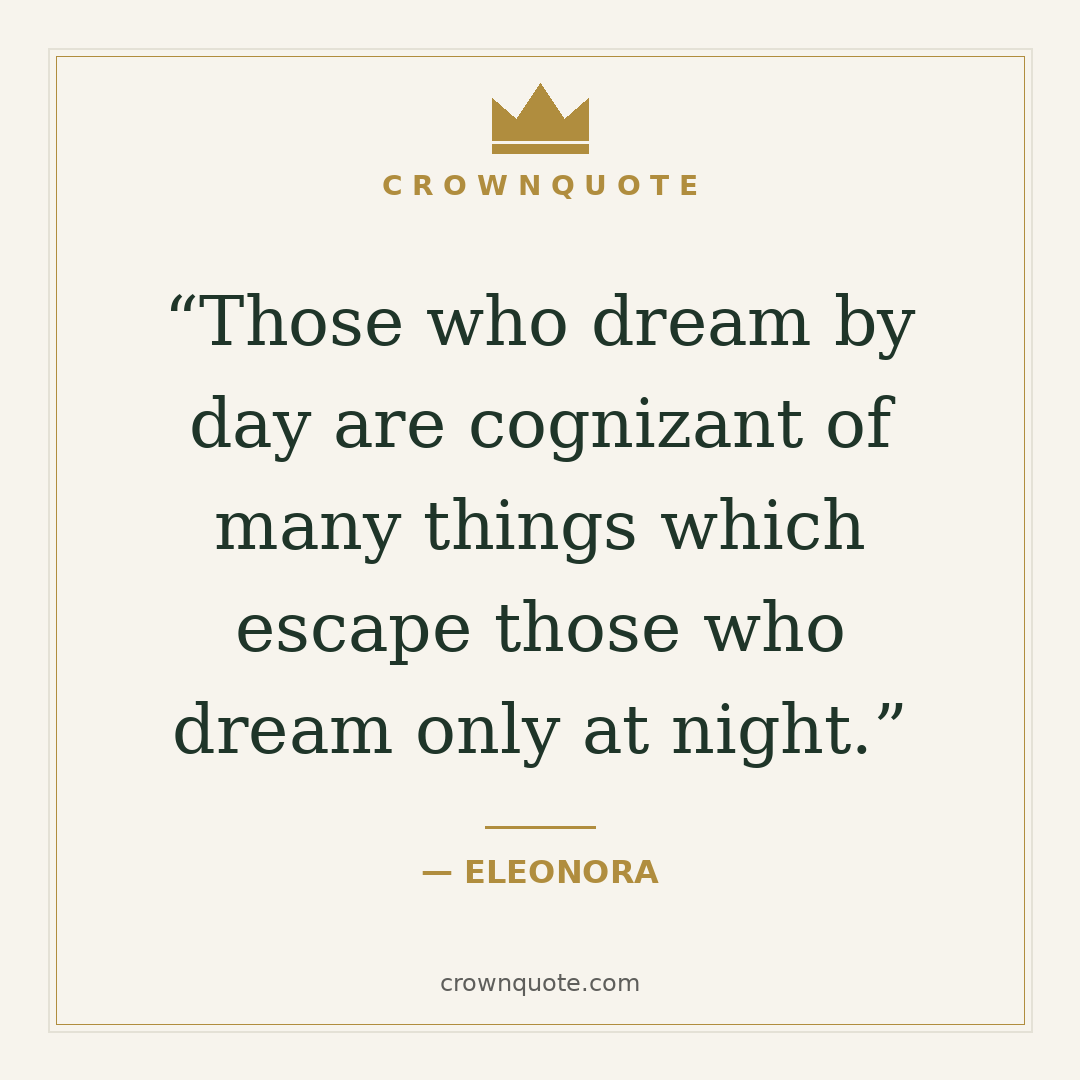
But a dream within a dream? — A Dream Within a Dream - They who dream by day are cognizant of many things which escape those who dream only at night. — Eleonora
- By a route obscure and lonely,
Haunted by ill angels only,
Where an Eidolon, named NIGHT,
On a black throne reigns upright — Dream-Land - I have reached these lands but newly
From an ultimate dim Thule —
From a wild weird clime that lieth, sublime,
Out of SPACE — out of TIME. — Dream-Land - In visions of the dark night
I have dreamed of joy departed —
But a waking dream of life and light
Hath left me broken-hearted. — A Dream - In spring of youth it was my lot
To haunt of the wide world a spot
The which I could not love the less —
So lovely was the loneliness
Of a wild lake, with black rock bound,
And the tall pines that towered around. — The Lake - At morn — at noon — at twilight dim —
Maria! thou hast heard my hymn! — Hymn - ‘Twas noontide of summer,
And mid-time of night;
And stars, in their orbits,
Shone pale, thro’ the light
Of the brighter, cold moon,
‘Mid planets her slaves,
Herself in the Heavens,
Her beam on the waves. — Evening Star - Resignedly beneath the sky
The melancholy waters lie. — The City in the Sea - Science! true daughter of Old Time thou art!
Who alterest all things with thy peering eyes. — Sonnet — To Science - Once it smiled a silent dell
Where the people did not dwell;
They had gone unto the wars,
Trusting to the mild-eyed stars — The Valley of Unrest - In the startled ear of night
How they scream out their affright! — The Bells
The Bells & His Music
- Hear the sledges with the bells —
Silver bells!
What a world of merriment their melody foretells! — The Bells - Hear the mellow wedding bells,
Golden bells!
What a world of happiness their harmony foretells! — The Bells - Hear the loud alarum bells —
Brazen bells!
What a tale of terror, now, their turbulency tells! — The Bells - Hear the tolling of the bells —
Iron bells!
What a world of solemn thought their monody compels! — The Bells - Gaily bedight,
A gallant knight,
In sunshine and in shadow,
Had journeyed long,
Singing a song,
In search of Eldorado. — Eldorado - But he grew old —
This knight so bold —
And o’er his heart a shadow
Fell as he found
No spot of ground
That looked like Eldorado. — Eldorado - And, as his strength
Failed him at length,
He met a pilgrim shadow —
“Shadow,” said he,
“Where can it be —
This land of Eldorado?” — Eldorado - “Over the Mountains
Of the Moon,
Down the Valley of the Shadow,
Ride, boldly ride,”
The shade replied, —
“If you seek for Eldorado!” — Eldorado - From childhood’s hour I have not been
As others were — I have not seen
As others saw — I could not bring
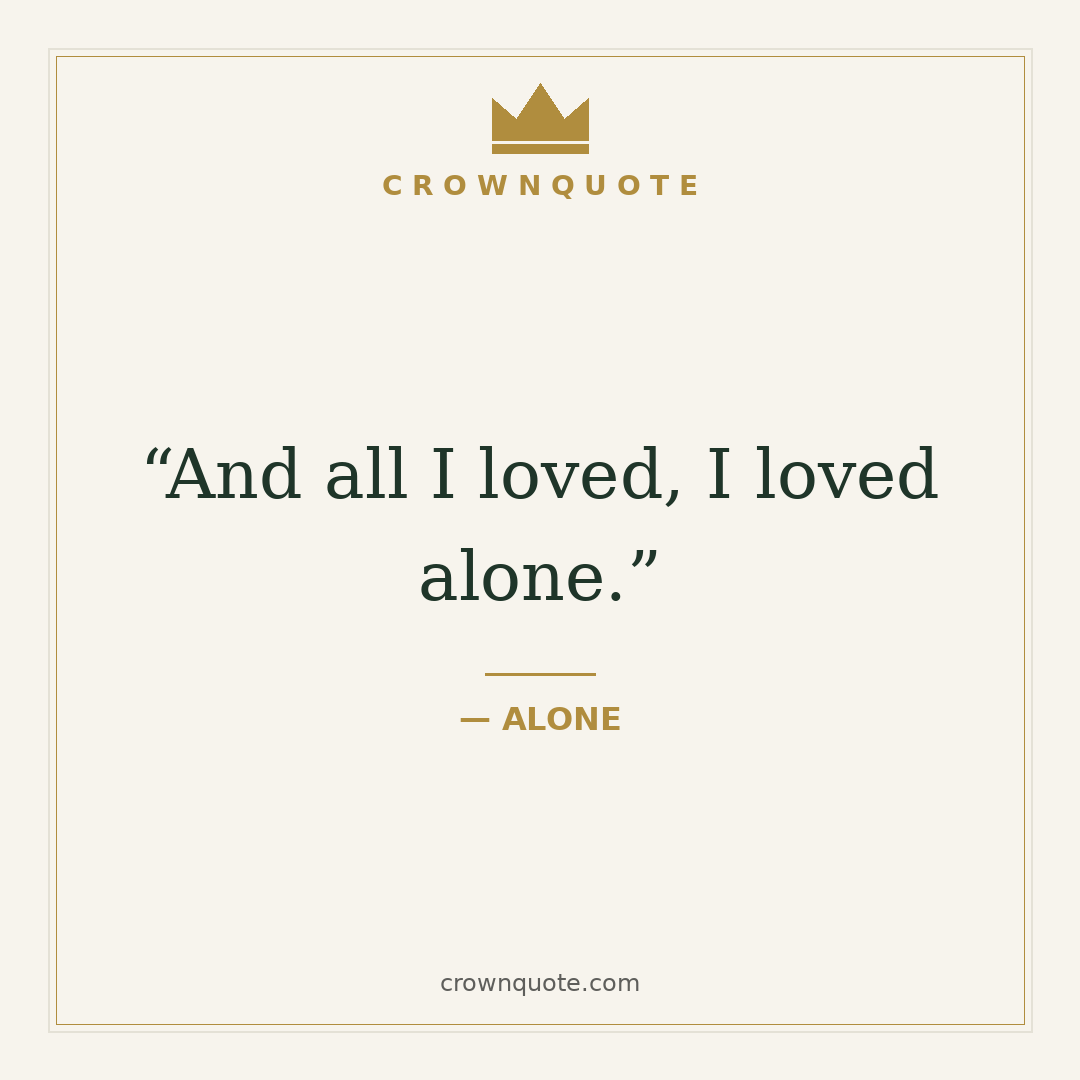
My passions from a common spring. — Alone - And all I loved, I loved alone. — Alone
- Romance, who loves to nod and sing,
With drowsy head and folded wing,
Among the green leaves as they shake
Far down within some shadowy lake — Romance - Dim vales — and shadowy floods —
And cloudy-looking woods,
Whose forms we can’t discover
For the tears that drip all over — Fairy-Land
Horror & Terror
- Words have no power to impress the mind without the exquisite horror of their reality. — The Narrative of Arthur Gordon Pym of Nantucket
- The thousand injuries of Fortunato I had borne as I best could, but when he ventured upon insult I vowed revenge. — The Cask of Amontillado
- For the half of a century no mortal has disturbed them. — The Cask of Amontillado
- In pace requiescat! — The Cask of Amontillado
- A wrong is unredressed when retribution overtakes its redresser. — The Cask of Amontillado
- I was sick — sick unto death with that long agony — The Pit and the Pendulum
- I struggled no more, but the agony of my soul found vent in one loud, long and final scream of despair. — The Pit and the Pendulum
- I could no longer doubt the doom prepared for me. — The Pit and the Pendulum
- She was a maiden of rarest beauty, and not more lovely than full of glee — The Oval Portrait
- In the strange anomaly of my existence, feelings with me, had never been of the heart, and my passions always were of the mind. — Berenice
- Nothing is more hateful to wisdom than excessive cleverness. — The Purloined Letter
- Let me call myself, for the present, William Wilson. — William Wilson
- There was an iciness, a sinking, a sickening of the heart — an unredeemed dreariness of thought which no goading of the imagination could torture into aught of the sublime. — The Fall of the House of Usher
- There are chords in the hearts of the most reckless which cannot be touched without emotion. — The Masque of the Red Death
The Fall of the House of Usher (1839)
- During the whole of a dull, dark, and soundless day in the autumn of the year, when the clouds hung oppressively low in the heavens, I had been passing alone, on horseback, through a singularly dreary tract of country — The Fall of the House of Usher
- I looked upon the scene before me — upon the mere house, and the simple landscape features of the domain — upon the bleak walls — upon the vacant eye-like windows — upon a few rank sedges — and upon a few white trunks of decayed trees — with an utter depression of soul which I can compare to no earthly sensation more properly than to the after-dream of the reveller upon opium — The Fall of the House of Usher
- I know not how it was — but, with the first glimpse of the building, a sense of insufferable gloom pervaded my spirit. — The Fall of the House of Usher
- He suffered much from a morbid acuteness of the senses — The Fall of the House of Usher
- I had so worked upon my imagination as really to believe that around about the entire mansion and domain there hung an atmosphere peculiar to themselves — The Fall of the House of Usher
- An excited and highly distempered ideality threw a sulphureous lustre over all. — The Fall of the House of Usher
- The room in which I found myself was very large and lofty. The windows were long, narrow, and pointed, and at so vast a distance from the black oaken floor as to be altogether inaccessible from within. — The Fall of the House of Usher
- Feeble gleams of encrimsoned light made their way through the trellised panes, and served to render sufficiently distinct the more prominent objects around — The Fall of the House of Usher
- I feel that the period will sooner or later arrive when I must abandon life and reason together, in some struggle with the grim phantasm, FEAR. — The Fall of the House of Usher
- Madman! I tell you that she now stands without the door! — The Fall of the House of Usher
- No sooner had these syllables passed my lips, than — as if a shield of brass had indeed, at the moment, fallen heavily upon a floor of silver — I became aware of a distinct, hollow, metallic, and clangorous, yet apparently muffled reverberation. — The Fall of the House of Usher
- And the deep and dank tarn at my feet closed sullenly and silently over the fragments of the House of Usher. — The Fall of the House of Usher
The Masque of the Red Death (1842)
- The “Red Death” had long devastated the country. No pestilence had ever been so fatal, or so hideous. — The Masque of the Red Death
- Blood was its Avatar and its seal — the redness and the horror of blood. — The Masque of the Red Death
- There were sharp pains, and sudden dizziness, and then profuse bleeding at the pores, with dissolution. — The Masque of the Red Death
- The prince had provided all the appliances of pleasure. — The Masque of the Red Death
- It was a voluptuous scene, that masquerade. — The Masque of the Red Death
- But the Prince Prospero was happy and dauntless and sagacious. — The Masque of the Red Death
- While the chimes of the clock yet rang, it was observed that the giddiest grew pale — The Masque of the Red Death
- There was a sharp cry — and the dagger dropped gleaming upon the sable carpet — The Masque of the Red Death
- And now was acknowledged the presence of the Red Death. He had come like a thief in the night. — The Masque of the Red Death
- And one by one dropped the revellers in the blood-bedewed halls of their revel, and died each in the despairing posture of his fall. — The Masque of the Red Death
- And the life of the ebony clock went out with that of the last of the gay. — The Masque of the Red Death
- And Darkness and Decay and the Red Death held illimitable dominion over all. — The Masque of the Red Death
Letters, Marginalia & Wisdom
- If you wish to forget anything upon the spot, make a note that this thing is to be remembered. — Marginalia
- That man is not truly brave who is afraid either to seem or to be, when it suits him, a coward. — Marginalia
- To vilify a great man is the readiest way in which a little man can himself attain greatness. — Marginalia
- We should bear in mind that, in general, it is the object of our newspapers rather to create a sensation — to make a point — than to further the cause of truth. — Marginalia
- Not in knowledge is happiness, but in the acquisition of knowledge! — The Power of Words
- In for ever knowing, we are for ever blessed; but to know all were the curse of a fiend. — The Power of Words
- Experience has shown, and a true philosophy will always show, that a vast, perhaps the larger, portion of truth arises from the seemingly irrelevant. — The Mystery of Marie Rogêt
- No thinking being lives who, at some luminous point of his life of thought, has not felt himself lost amid the surges of futile efforts at understanding, or believing, that anything exists greater than his own soul. — Eureka: A Prose Poem
- Coincidences, in general, are great stumbling-blocks in the way of that class of thinkers who have been educated to know nothing of the theory of probabilities — The Murders in the Rue Morgue
- Believe nothing you hear, and only one half that you see. — Attributed to Edgar Allan Poe
- In criticism I will be bold, and as sternly, absolutely just with friend and foe. — Marginalia
- There is no passion in nature so demoniacally impatient, as that of him who, shuddering upon the edge of a precipice, thus meditates a plunge. — The Imp of the Perverse
- He is fond of enigmas, of conundrums, of hieroglyphics; exhibiting in his solutions of each a degree of acumen which appears to the ordinary apprehension præternatural. — The Murders in the Rue Morgue
- We have no aristocracy of blood, and having therefore no aristocracy of fact, the aristocracy of fashion is necessarily respected — The Philosophy of Furniture

Short & Shareable Lines
- Eagerly I wished the morrow; — vainly I had sought to borrow
From my books surcease of sorrow — sorrow for the lost Lenore —
For the rare and radiant maiden whom the angels name Lenore —
Nameless here for evermore. — The Raven - ‘Tis some visitor,” I muttered, “tapping at my chamber door —
Only this and nothing more.” — The Raven - Darkness there, and nothing more. — The Raven
- ‘Tis the wind and nothing more! — The Raven
- Swung by Seraphim whose foot-falls tinkled on the tufted floor. — The Raven
- This I sat engaged in guessing, but no syllable expressing
To the fowl whose fiery eyes now burned into my bosom’s core — The Raven - A dirge for her the doubly dead in that she died so young. — Lenore
- Come! let the burial rite be read — the funeral song be sung! — Lenore
- It crawls — it writhes — it writhes! — with mortal pangs
The mimes become its food — The Conqueror Worm - Bottomless vales and boundless floods,
And chasms, and caves, and Titan woods — Dream-Land - The mystery which binds me still:
From the torrent, or the fountain,
From the red cliff of the mountain — Alone - Yes, Heaven is thine; but this
Is a world of sweets and sours;
Our flowers are merely — flowers — Israfel - On desperate seas long wont to roam,
Thy hyacinth hair, thy classic face,
Thy Naiad airs have brought me home — To Helen - Some sepulchre, remote, alone,
Against whose portal she hath thrown,
In childhood, many an idle stone — The Sleeper - The sickness — the nausea —
The pitiless pain —
Have ceased, with the fever
That maddened my brain — For Annie - It was the vault of the lost Ulalume! — Ulalume
- Then my heart it grew ashen and sober
As the leaves that were crispèd and sere — Ulalume - In the silence of the night,
How we shiver with affright
At the melancholy menace of their tone! — The Bells - To the moaning and the groaning of the bells. — The Bells
- Keeping time, time, time,
In a sort of Runic rhyme — The Bells - Be silent in that solitude,
Which is not loneliness — for then
The spirits of the dead who stood
In life before thee are again
In death around thee — Spirits of the Dead - Death was in that poisonous wave,
And in its gulf a fitting grave
For him who thence could solace bring
To his lone imagining — The Lake - Up many and many a marvellous shrine
Whose wreathed friezes intertwine
The viol, the violet, and the vine — The City in the Sea - No holy rays from heaven come down
On the long night-time of that town — The City in the Sea
Quotes Often Misattributed to Poe
A few famous lines travel the internet under Poe’s name. Here is what the record actually shows:
- “Believe nothing you hear…” — widely attributed to Poe online, but no source in any of his poems, tales, essays or letters has ever been found. NOT Poe.
- “Sleep, those little slices of death — how I loathe them” — Circulates on quote sites as Poe, but it appears in none of his published works. NOT verified as Poe.
- “The scariest monsters are the ones that lurk within our souls” — A modern internet invention with Poe’s name attached. NOT Poe.
- “We loved with a love that was more than love” — REAL — from “Annabel Lee” (1849).
- “Never to suffer would never to have been blessed” — REAL — from “Mesmeric Revelation” (1844).
- “I became insane…” (the Eveleth letter line) — REAL — from his letter to George W. Eveleth (1848).
- “I have great faith in fools” — REAL — from his “Marginalia” (1849).
How to Use These Quotes
- Pair a Raven line with a dark, moody photo for a gothic Instagram caption.
- Use an Annabel Lee stanza in a love letter or anniversary card.
- Open a Halloween party invitation with a line from The Masque of the Red Death.
- Quote his Marginalia in essays about writing, truth, or human nature.
- Every attribution names the exact work — keep it when you share, so the line stays honest.
More Edgar Allan Poe Quotes to Explore
- Dream quotes — for the visions Poe chased by day and night
- Love quotes for him — devotion in the spirit of Annabel Lee
- Good night quotes — midnight musings for the dark hours
- Art quotes — beauty, poetry, and the rhythmical creation
- Wisdom quotes — sharp truths from great minds
- Sad quotes — sorrow, loss, and the golden bowl broken
- William Shakespeare quotes — the Bard’s timeless lines
- Oscar Wilde quotes — wit from another dark romantic
- Mark Twain quotes — American letters, another giant
- Life quotes — on living, dying, and the shadowy line between
- 200 best quotes of all time — the essential collection
- Aesthetic Instagram captions — moody lines for your feed
Frequently Asked Questions
What is Edgar Allan Poe’s most famous quote?
“Quoth the Raven, ‘Nevermore'” — the refrain of The Raven (1845), the poem that made Poe a household name. It is the single most quoted line in all of American poetry.
Did Poe really say “Believe nothing you hear, and only one half that you see”?
No verified source exists in any of Poe’s poems, tales, essays, or letters. It is one of several lines the internet attributes to him without evidence, listed in our misattributed section above.
What are Poe’s most famous poems?
The Raven (1845), Annabel Lee (1849), The Bells (1849), Ulalume (1847), The Conqueror Worm (1843), and Eldorado (1849) — all quoted with citations in this collection.
Where can I read Poe’s complete works for free?
Poe’s works are in the public domain. The Poetry Foundation hosts his poems free online, and the Edgar Allan Poe Society of Baltimore (eapoe.org) publishes authoritative texts of his tales and essays.

CURATED BY